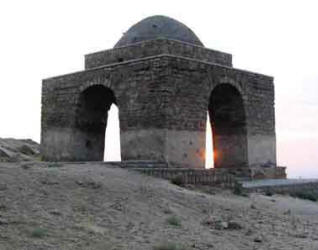
The primary religion in Iran today is the Shia sect of Islam but the far older faith of the prophet Zoroaster is still openly practiced, particularly in the central and northwestern regions of the country. Zoroaster's name in its original form is found in the sacred scripture the Avesta as Zarathushtra. It is not possible to say exactly when he lived but contemporary scholarship has mostly agreed upon the dates of 660-583 BC, with his birthplace being in the region of northwestern Iran now known as Azerbaijan. Similar to other great sages of archaic times, Zoroaster's life is part history and part legend. Tales are told of signs in the sky announcing his coming, of marvels and omens attending his birth, and of acts of power that he performed as a young boy. Around the age of twenty he withdrew from the world to seek the divine through study, wandering and solitary meditation in remote mountain areas. At the age of thirty he experienced the first of seven mystical visions from which he developed his spiritual philosophy and initiated his ministry. In these visions, an angelic entity by the name of Vohu Manah appeared to Zoroaster and escorted him to the throne of the Creator, Ahura Mazda. The wisdom teachings he received from Ahura Mazda are given in the form of seventeen hymns, the Gathas, contained in the Avesta scripture. The Zoroastrian religion has three central commands of Good Thoughts, Good Words, and Good Deeds.
Zoroaster was born in an age of agriculturalists and his religion is therefore deeply associated with the natural world. Besides its emphasis on the eternal conflict of good and bad, Zoroastrianism is also characterized by nature worship, by deification of the sun, moon and stars, and by scrupulously followed injunctions regarding the protection of the earth. In the Zoroastrian faith, reverence is shown to the Creator Ahura Mazda both directly and through the veneration of his various creations and their supernatural guardians. Fire is believed to pervade the other six principal creations and is always present at Zoroastrian ceremonies. During their prayers, believers face towards a fire, or else towards the sun or the moon, which are regarded as heavenly fires and as Ahura Mazda himself. Fire is, however, not regarded as a symbol but as a holy being that comes to man's assistance in return for nourishment and worship. The veneration of fire is also equated with the invocation of truth in the mind and heart of the believer.
The practice of Zoroastrian pilgrimage in contemporary Iran is similar to that of pre-Islamic Persia, though practiced on a vastly reduced scale. In the early period of the religion, it seems that the hearth-fire of each family dwelling was used for worship but that around the 4th century BC communal temples began to be constructed. Fire temples were built in villages and cities, and at remote places in the high mountains sacred rocks, caves and holy springs were venerated. Mythological and archaeological evidence indicates that these mountain sites had been pagan sacred places well before the development of Zoroastrianism. The Greek historian Herodotus, writing in the 5th century BC, made the comment about the early Zoroastrian use of their mountain shrines, "It is not their custom to make and set up statues and temples and altars but they offer sacrifices on the highest peaks of the mountains." Over the centuries of use, however, these natural sacred sites were elaborated and simple temples were built. These mountain shrines, more so than the fire temples of the cities and villages, became the focus of the Zoroastrian pilgrimage tradition.
With the coming of Islam in the 7th century AD, Zoroastrianism lost its position as the dominant religion, large numbers of Zoroastrians converted to Islam, and many remote shrines were abandoned and forgotten. The mountainous region of central Iran around the city of Yazd became a stronghold of Zoroastrianism and today remains the only significant area where shrine pilgrimage is still practiced according to the ancient traditions. There are six holy shrines (called pirs or pirangah) in the Yazd region and the yearly pilgrimages to them are an occasion for the gathering of members of different villages. Although each village has its own fire temple where initiations, agricultural festivals and funeral ceremonies are held, the annual pilgrimages to Pir-e Sabz and the other five mountain shrines are the most important religious periods of the year. Pilgrims may visit any of the shrines throughout the year but the religious benefit is considered greatest when an individual participates in the communal yearly pilgrimages. Pilgrimage ceremonies at the shrines generally last for five days and the pilgrimages themselves are referred to by the Muslim term hajj. Pilgrimage is simultaneously an undertaking of spiritual significance as well as an opportunity for feasting, music and dancing.
Writing on the founding legends of the six major shrines in the Yazd region, Michael Fischer comments that their "mythical origin is a variant of the Bibi Shahbanu legend, namely, that at the time of the Arab invasion a daughter or son or member of the court of Yazdegird III fled before an Arab army towards Khorassan, came to a point of exhaustion near Yazd, called upon God, and was taken into the mountain, rock, well, or cave before the bewildered Arab eyes. The second part of the legend concerns a process of rediscovery. That is to say, the location of these sites of ascension to the next world was lost. Then, in relatively recent times, they were rediscovered by a shepherd, child, or other person in need, to whom a spirit or saint (pir) appeared in a vision or a dream. This spirit aids the human protagonist by solving the mystery of lost sheep, lost path, and so on, requesting in return that a shrine be built." This legend, commonly used by devout Zoroastrians in order to sanctify their mountain shrines, is however, known to date from an historical period demonstrably more recent than the shrines themselves. The Zoroastrian mountain shrines of the Yazd region were used as holy places long before the birth of Islam and therefore predate any legends associated with that religion. The six shrines are:
- Pir-e Sabz (Chak-Chak); 72 kilometers from Yazd, near Ardakan; pilgrimage period June 14-18.
- Seti Pir; east of Yazd, pilgrimage period June 14-18, often visited on the way to the shrine of Pir-e Sabz.
- Pir-e Narestuneh (Narestan); Kharuna mountains, six miles east of Yazd; pilgrimage period: later part of June, after Pir-e Sabz.
- Pir-e Banu-Pars; near Sharifabad; pilgrimage period in early July.
- Pir-e Naraki; at the foot of Mt. Nareke, south of Yazd; pilgrimage period in mid-August.
- Pir-e Herisht; near Sharifabad.
The shrine of Shekaft-e Yazdan (the 'Cleft of God') in the Tutgin valley near the village of Zardju is sometimes visited after the pilgrimage to the shrine of Pir-e Banu-Pars. (Another sacred site in the Yazd region is the Muslim shrine of Haji Khezr, in the town of Kuhbanan.)
Pir-e-Sabz shrine
For Iranian Zoroastrians, summer begins with the pilgrimage to Pir-e-Sabz. This remote site is the holiest and most visited of the Zoroastrian mountain shrines. Shrine legends tell of a conquering Arab army that had pursued Nikbanoo, the daughter of the Sassanian Emperor Yazdgird III, to this region. Fearing capture, she prayed to Ahura Mazda to protect her from the enemy. In the nick of time the mountain miraculously opened up and gave her protection. This legendary site, where a holy spring issues from the towering cliff, is also called Chak-Chak, which means 'drop-drop' in Persian. Growing beside the source of the holy spring is an immense and ancient tree which legends says used to be Nikbanoo's cane, and the waters of the spring are believed to be tears of grief shed by the mountain for Lady Nikbanoo. The shrine enclosure, a man-made cave, is floored with marble and its walls are darkened by soot from the fires kept eternally burning in the sanctuary. Each year from June 14 to 18, many thousands of Zoroastrians from Iran, India and other countries flock to the temple of Pir-e Sabz. One of the pilgrim trails to Chak-Chak is a dirt road starting near the village of Elabad, north of Yazd. It is a time-honored tradition for pilgrims to stop the moment they see the sight of the shrine and continue the rest of their journey by foot. Several roofed pavilions have been constructed on the cliffs below the shrine and throughout the day and night these are tightly packed with pilgrims.
Notes on Zoroastrian sacred mountains
Sources of information on Zoroastrian sacred mountains are found in parts of Zoroastrian Avesta literature known as Zamyad Yasht and the Pahlavi Bundahishn.
Mt. Ushi-darena (translated as 'Support of Divine Consciousness' or 'Sustainer of Divine Wisdom') is the mountain where Zoroaster attained illumination and received the revealed knowledge of the supreme god, Ahura Mazda. Another Zoroastrian saint mentioned in the Avestan Yasht literature, Asmo-Khanvant, also attained spiritual illumination upon Ushi-Darena. This mountain appears to be situated in the Mt. Alborz range near Azerbaijan, Zarathustra's traditional birthplace. The Bundahishn, however, places it in Seistan (or Sajestan), east of Iran in the region referred to in the Avesta (Vendidad I, 9-10) as Vaekereta, the ancient name of Kabul (or Sajestan). The Greeks called in Dranjiana and in the Pahlavi writings it is known as Hushdastar.
Mt. Asnavant, now known as Mt. Ushenai in the Azerbaijan region near the sacred lake of Chaechasta (also known as Urumiah). Asnavant is another mountain where Zarathustra lived for a number of years practicing solitary meditation. In the Bundahishn, Mt. Asnavant is referred to as the seat of Adar Gushasp, the Sacred Fire. It is on this mountain where Zarathustra is believed to have gained the power and energy to go out into the world as a great spiritual teacher, while it was on Mt. Ushi-Darena that he achieved the realization of that which he later taught. The legends of Mt. Asnavant indicate that it has a power that dispels ignorance and develops purity.
Mt. Hara-Berezaiti, identified as Mt. Alborz. The Bundahishn mentions as existing at this mountain a "Bridge of Judgement" or "Bridge of Moral Discrimination" which is a pathway leading to the Otherworld. This bridge or pathway is supposed to run between two mountains, Chakad-e-Daitik and the Arezur ridge of Mt. Alborz. The Zoroastrian scriptures tell of a saintly king, Yima Vivanghvant, who received the power of prophecy from Ahura Mazda upon this mountain.
For further information on the sacred sites and pilgrimage practices of Zoroastrianism, consult the following sources:
- A Persian Stronghold of Zoroastrianism; by Mary Boyce; Oxford Press; 1977
- Sacred Circles: Iranian (Zoroastrian and Shi'ite Muslim) Feasting and Pilgrimage Circuits; by Michael Fischer; in Sacred Places and Profane Spaces, edited by Jamie Scott; Greenwood Press, New York; 1991
- The Zoroastrians of Iran: Conversion, Assimilation, or Persistence; by Janet Amigh; AMS Press, New York; 1990
- Zoroastrianism in Armenia; by James Russell; Harvard University Press, Cambridge; 1987
Additional notes on Zoroastrian pilgrimage and sacred sites:
Geographical characteristics and the origin of the Zoroastrians' pilgrimage places in Iran
Introduction
Probably the most important holy places in Iran for Zoroastrians are pilgrimage places near Ardakan, Aghdâ, Mehriz, and Yazd, located in Yazd province, central Iran. These holy places are visited every year by hundreds of Zoroastrians not only from different parts of Iran, but also from different parts of the world. The aim of this article is to highlight the significance and characteristics of these historical and religious places.
The pilgrimage places that will be considered in this article are: Pir-e Sabz, Pir-e Herisht, Pir-e Narestaneh, Pir-e Banoo, and Pir-e Naraki.
Geographical locations
Except Pir-e Herisht, all other pilgrimage places are located on or near the mountainous slopes. The locations of these pilgrimage places are shown in table 1. The nearest of these holy places to Yazd is Narestaneh and the furthest one is Pir-e Banoo.
Table 1: The locations of Zoroastrians' pilgrimage places compared to the Yazd and other nearest cities.
| Pilgrimage Place | Location compared to Yazd | Location compared to other cities |
| Pir-e Sabz | 65 km northwest | 40 km northeast of Ardakan |
| Pir-e Herisht | 90 km northwest | 15 km northeast of Ardakan |
| Pir-e Narestaneh | 30 km north | _______ |
| Pir-e Banoo | 110 km west | 12 km south of Aghdâ |
| Pir-e Naraki | 55 km southeast | 15 km west of Mehriz |
Pir-e Sabz (Chak Chaku) is located on the slope of Chak Chak Mountain in an abandoned area (Plate 1). A secondary road from Ardakan to Khorânagh village is passing in 14 km distance. Pir-e Herisht was built on a small hill and it is about 5 km from a secondary road to Khor (means sun) in the heart of the Dasht-e Kavir (The Great Kavir). A small farm and spring, called Howz-e Gowr (Zoroastrian pool), is the nearest place to the Herisht located at 14 km distance near the road towards the Khor.
Narestaneh is located in one of the valley sides of the Narestaneh Mountain, which is also a remote place. The nearest village to this holy place is Dorbid located 7 km to the north. The last time (1990) that I visited this village two shepherd families were living there. One of the shepherds pointed to the remnants of an old fire temple of Dorbid. It had been demolished and levelled to the ground by local people (mainly from the city) who wanted to build a mosque instead.
Pir-e Banoo is the furthest pilgrimage place to Yazd and is located in one the several valleys inhabited by local farmers, shepherds and hunters. It is near to Aghdâ, an area full of ancient Persian names, as well as, new Arabic names. Persian names such as Ormudeh, Ashtigah (peace place!), Desgin, Parpar, Haftador (Hapt Ador = Seven Fire) seems to be historical.
Archaeological characteristics
No archaeological evidence has been found in these holy places so far to suggest antiquity or very ancient age of the features. Probably the oldest building belongs to Pir-e Banoo could not be older than 200 years due to its architectural elements and materials and also according to the existed inscriptions. Possibly the older buildings or structures had been demolished naturally or during rebuilding process.
One can assume that these places were important for many centuries, before the renewing of the firealtar buildings took place. Although the archaeological evidence is absent in these places there are some evidence from nearby areas. In the Aghdâ Mountain near Zarjoo village (adjacent to Pir-e Banoo) a historical cave has been found with evidence of compacted and cemented remnants of debris from a fireplace. Nobody until now has tried to investigate the exact age of the inhabitancy of this cave and the age of the fireplace. In the Naraki case, for instance, several archaeological tools and sculptures have been found near Mehriz, which have been interpreted as Achaemenid remnants. However, there is no clue to find out any relationship between the archaeological evidence found in nearby areas and the occurrence of the holy places.
There are rumours among the local peoples about historical treasures, which have been found by local shepherds and foreign passengers. Local people talking about points that they have found coins, broken jewellers, dagger, and human skeletons around the pilgrimage places. Unfortunately, in several cases, the archaeological evidence of human activities have been removed or destroyed by persons who were looking for valuable treasures.
Theories on the origin of these holy places
One of the earliest and most conventional theories about the origin of these holy places is related to the time of Arab invasion. The beginning of the event, according to this theory, is related to the chasing of the daughters or relatives of Yazdgerd the Third, the last Sassanian king of Iran by foreign invaders. The family of the king, and particularly his daughters with their treasures, were moving towards Khorasan. Khorasan is located to the northeastern part of the country and it was much larger than today during the Sassanian period. The aim of the Yazdgerd relatives was to escape from the Arab invaders to a safer place far away from Pars, which was the mainland of Sassanian. The legend stories explain that during the journey towards Khorasan when Yazdgerd family reached to the Aghdâ Mountains the chasers were very near to catch them. As a result, the relatives of the king separated into different groups and tried to escape into different mountains. The legend concluded that in the last minutes of the journey when the travellers were near to be captivated the innocent girls or women prayed to the God for protection. Consequently, the God helped them and they were disappeared into the opening fissures or buried by falling rocks. Old Zoroastrians explain that many years ago a petrified colourful cloth was visible near Pir-e Banoo and they believe that it was part of a woman dress. However, the conglomerate rocks of Pir-e Banoo area are full of colourful stones, which resemble colourful clothes (plate?).
The second theory is similar to the first one but, in this version, the internal rebels are replaced with foreign invaders. According to this theory, during the wars between Sassanian army and Arabs at western border of Persia, there were upheavals inside the country by some of the opposition groups. The son (or one of the relatives) of Bahrâm Chubineh, a grand general of the previous king (Khosro Parviz), for example, leaded one of these opposition groups. Whatever the reason behind the conflict, the rebels tried to cut the Yazdgerd family during their journey towards Khorasan, most likely to pillage the kingdom treasury, which they carried away. The rest of the story is the same as the first one: disappearance of the innocent people (particularly girls and women) inside the suddenly opened ground.
The third narrative, which is also related the origin of some of the Moslems holly buildings (imamzadeh) in Iran, related to the most economical point of view. According to this theory, these holy places, or their nearby lands, were the hiding places of treasures of the Yazdgerd or other Sassanian nobles. During their escape from the Arab invaders, or from internal rebels, the chance of rescue was much lower if they stuck to their heavy treasures. On the other hand, if the climate conditions were drier than the present time, which meant less access to water, there was no need to have the chasers behind for get ridding of the heavy and dangerous cargo. This was probably the case, if they had lost their horses or mules and had to continue the rest of the journey by walking. As a result, according to this theory, they buried the treasures wherever possible with more or less a vague record about their burial locations. The holiness of those places were created afterward either by local people, who were interested in keeping the treasures safe, or by the survivors if any.
The forth notion about the origin of these holy places is related to the Anahita (in Avesta: ardevi sura anahita). Anahita was the goddess or Izad of water, rain, rivers, love, motherhood and birth (Frahvashi, 1987). Although from those holy places only two, Pir-e Sabz and Naraki, have waterfalls at the present time such features may have been more active during the wetter conditions of historical times (Mobed Rostam Shahzadi, personal communication, March 1989). Furthermore, rivers and springs were much more active in these places during that period, while nowadays there are some small amounts of underground water or narrow intermittent streams. Waterfalls and springs within such places had been functioned as the holy place of Anahita, probably earlier than Zoroastrian period, under Mithraism effects. One can assume the water in such arid environments was too precious and praiseworthy that the occurrence of springs, waterfalls and rivers was connected to Izad Anahita as the source of this valuable features.
A clue for this idea is that most of these holy places are initiated in relation to the women rather than men. For example, Banoo in Pir-e Banoo means lady or gentlewoman. Another example is Pir-e Sabz, which is related to Hayat Banoo, a holy woman although with an inverted Arabic name. There is also a similar story for the initiation of Pir-e Naraki in relation to a holy lady. All of these relationships together, according to this theory, could be originated by the effect of Izad Anahita, which then, converted to more acceptable story of Yazdgerd daughters and later on due to necessity converted to the story of those holy ladies with Arabic names.
The fifth and the last theory is the "immigration stations theory". I believe that these important and valuable pilgrimage places were, in fact, a chain of stations and the last farewell places towards the India. After 1100 AD (5th century of khorshidi) the immigration of Zoroastrians towards east was accelerated due to a rapid increase in hardship life and limitation on their activities. Zoroastrians all over Persia, from Azerbaijan and Aran (Eran), to Susiana (Khuzistan); and from Alborz to Zagros Mountains, were subject of continues discrimination and persecution afterwards. As a result, a wave of immigration continued with movement of several groups of people towards the east.
Yazd and Ardakan deserts had two remarkable characteristics; one was their isolation from the other parts of Iran, and another was their central location within the Persia. The isolation was due to the occurrence of extensive deserts and kavirs around the Yazd-Ardakan area and this area (with Nain) was geographically the central part of the Iranian Plateau. On the other hand, one can assume that during those dark and harsh days the Zoroastrians caravans were trying to do not attract any attentions. As a result, it was reasonable to avoid crossing major roads and cities. The vital needs of the caravans were water and food, both of these were relatively available in the abandoned mountainous areas of Aghda, Ardakan and Yazd. The wild goat, wild sheep and partridge were much more abundant than today and the water supply was probably better than now due to a wetter climate.
Whether or not those holy places were functioning during those days as pilgrimage, they were used as stations during the long journey of Zoroastrians towards the east. Varieties of Zoroastrian accents in Yazd, Ardakan and Taft areas could be a testimony to the effect of such immigration and mixture events. It was highly possible that many of those travellers settled down in Ardakan, Yazd, Aghda and Taft areas.
These places may have also been used as temporary shelters during local or regional disturbances when the Zoroastrians were seriously under pressure. For example, the period of Sultan Hosain Safavi, the last king of Safavi dynasty, was one of the darkest sequences of Zoroastrians history. During the last few months of the Sultan Hosain life, Zoroastrians were seriously under attack and persecution. There are some oral memories about those days with Zoroastrians escaping to the mountain areas of Isfahan, Nain, Aghda, Ardakan and Yazd. During such suffering times the local mountains with a suitable source of water were more likely of high interest for Zoroastrians. Although those dark days have finished the Zoroastrians still come together in these "piroon" places whatever the origin and reason of their genesis are. These pilgrimages at the present time are not only functioning as praying places but also they are, at the same time, lovely places for entertainment and happiness.
Conclusion
The Zoroastrians pilgrimages of Yazd are conventionally believed to be originated from the end of Sassanian dynasty as the martyrdom places of Yazdgerd daughters. There is also another notion, which consider these places as Anahita worships in origin.
Considering the geographical, geological and historical conditions of the Yazd-Ardakan area, the holy places may were functioned as temporary shelters for Zoroastrian caravans travelling towards India.
They deserved to be holy places, whether or not their holiness belongs to Anahita or to the King Yazdgerd daughters. They deserved to be pilgrimage places because they carry a long history of faith, resistance, love, hope and survival.
Reference:
Dr Daryoush Mehrshahi FEZANA Journal,USA, Fall 1999, p.55-57.
Door of the inner sanctum, temple of Chak Chak